


PWR-03 · Power continuity
UPS systems sized for the load, the autonomy and the room they sit in
A UPS keeps security and network equipment running through outages, voltage dips and the seconds before a generator takes over. We size it from the real load, choose the topology for the site's power quality, and design the battery room so the batteries last.
Online or line-interactive

In an online double-conversion UPS the load always runs from the inverter: incoming mains is rectified to DC and converted back to clean AC. When mains fails there is no transfer at all, and the load is isolated from dips, surges, frequency drift and noise. A line-interactive UPS feeds the load from mains through a voltage regulator and switches to its inverter when mains fails, which takes a few milliseconds.
| Online double-conversion | Line-interactive | |
|---|---|---|
| On mains failure | No transfer; the inverter is already carrying the load | Transfer to inverter in a few milliseconds |
| Output on poor mains | Regulated voltage and frequency from the inverter | Voltage corrected within limits; frequency follows the supply |
| On a generator | Tolerates frequency drift within its input window | May switch to battery repeatedly on an unstable supply |
| Efficiency and heat | Lower in double-conversion mode; more heat to remove | Higher |
| Typical use | Recorders, core switches, control rooms, server racks | Single workstations, small edge cabinets on a stable supply |
Many online units offer an eco or high-efficiency mode that runs the load on mains and brings back a short transfer time. We state in the design where that is acceptable and where it isn't.
Every online UPS has a static bypass that moves the load to mains if the inverter fails or is overloaded. We also specify an external maintenance bypass, so the UPS can be isolated, repaired or replaced without shutting the systems down. Its interlocking and labelling are checked at commissioning, because a wrongly operated bypass is a common cause of outages during maintenance.
Sizing by load and autonomy

We start from a list of what must stay on: recorders, core and PoE switches (with the PoE power actually drawn), access controllers and lock power supplies, intercom servers, control room workstations and displays. Where the equipment is already running we measure it, because nameplate values add up to far more than the real load.
- Rating: UPS ratings are given in kVA and kW, and for modern IT loads with a power factor close to 1 the kW figure is the limit. We keep the steady load at around 70–80 % of the kW rating, leaving room for inrush and growth.
- Autonomy: set by what happens after the outage starts. With a generator the UPS only has to bridge start, transfer and stabilisation, but we add margin for a failed first start. Without one, autonomy is however long the site must keep operating on its own.
- End of life: batteries lose capacity as they age. We size so the autonomy still holds near the end of the battery's expected life, not only on the first day.
- Distribution: separate output circuits so a fault on one device doesn't take down the rest, with protection chosen to trip on the limited fault current an inverter can supply.
Runtime is not linear. Halving the load on the same battery more than doubles the runtime, which is one reason we separate critical loads from those that can wait for the generator.
Batteries, heat and testing

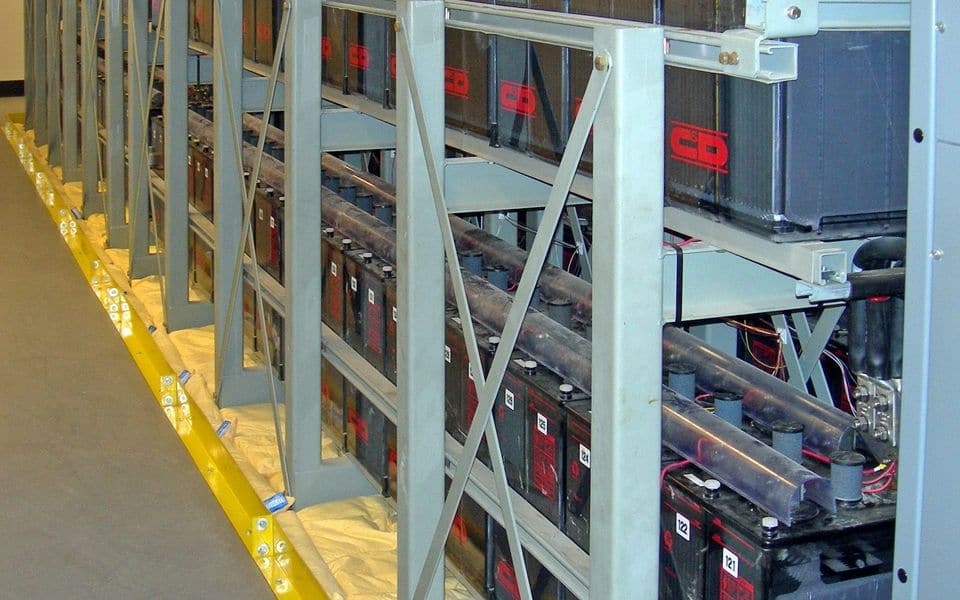
Valve-regulated lead-acid (VRLA) batteries are still the most common choice for UPS. Their life is rated at 25 °C and roughly halves for every 8–10 °C of sustained increase. A battery in a room that sits at 35 °C through a Saudi summer may need replacing in about half the time its datasheet suggests. Lithium-ion is increasingly used where space, weight or long life matter.
| VRLA | Lithium-ion | |
|---|---|---|
| Size and weight | Larger and heavier | Smaller and lighter for the same energy |
| Heat | Life roughly halves per 8–10 °C above 25 °C | Also ages faster when hot, but generally tolerates heat better |
| Monitoring | External block monitoring recommended | Built-in battery management system (BMS) |
| Upfront cost | Lower | Higher; can be lower over the life of the system |
| What to check | Ventilation for charging gases, string balance | Compatibility between UPS and BMS, and the authority's requirements for the battery room |
Cooling is part of the design: a battery room with its own air-conditioning on a reliable setpoint, not shared with an office unit that is switched off at night, and a temperature sensor that raises an alarm.
- Visual and connection checks: terminals, torque, swelling, leakage and corrosion.
- Impedance or conductance per block, trended over time to find weak blocks before they fail under load.
- Capacity (discharge) tests against a known load to confirm the real autonomy, at commissioning and periodically after.
- UPS checks: event log review, fans and filters, and a controlled transfer to bypass and back.
We provide design, installation, commissioning and maintenance services. The UPS and its batteries are procured by you or your contractor against our specification.
Our part, start to finish
What we do on a UPS project
We don't sell the equipment. We design the system, install and commission it, and keep it working.
Design & consulting
- Critical load list with measured loads
- Topology, rating and autonomy
- Battery type and battery room cooling
- Bypass and output distribution design
Installation
- UPS and battery installation
- Maintenance bypass and distribution wiring
- Battery commissioning and initial charge
- Load and mains-failure tests, with records
Maintenance
- Battery impedance trending
- Periodic capacity tests
- UPS log, fan and filter checks
- Battery replacement planning
Before you buy
Questions to settle first
These decide cost and performance more than the brand on the box. We work through them with you at survey stage.
- Which loads must stay on, and are they measured or estimated?
- Is there a generator, and how long until it carries the load?
- Without a generator, how long must the site run on battery?
- Where will the UPS and batteries sit, and how hot does that room get in summer?
- Can the systems be shut down for UPS maintenance, or is a maintenance bypass needed?
- Who will see battery and UPS alarms, and act on them?
Works alongside
Related systems

Power continuity
How UPS, central battery, generator and solar fit together.
Read more
Generator interfaces
ATS, transfer and the loads behind a standby generator.
Read more
Central battery systems
Monitored power for emergency lighting to EN 50171.
Read more
Solar PV
On-grid, hybrid and off-grid PV for buildings and remote points.
Read moreGallery
UPS systems in context
Illustrations show typical arrangements, not specific projects. Select an image to enlarge it.