



SEC-01 · Security & access
Video surveillance that answers the question you'll actually ask
After an incident nobody asks how many cameras you have. They ask whether the footage shows a face, a plate or what happened at the door. We design every view to answer that.
Start from the task, not the camera count

Each camera position gets a written purpose before a model is chosen: identify a person at the main entrance, read plates at the barrier, observe movement across a loading yard. The purpose sets the pixel density the scene needs, and pixel density sets the lens, the resolution and the mounting position.
IEC 62676-4 gives the working scale. It defines operational requirements by pixels per metre (px/m) measured horizontally at the target:
| Task (DORI) | Pixel density | What you can reliably do | Scene width with 4 MP (2560 px) |
|---|---|---|---|
| Detect | 25 px/m | Tell that a person or vehicle is present | ≈ 102 m |
| Observe | 62.5 px/m | See activity, clothing colour, direction of movement | ≈ 41 m |
| Recognise | 125 px/m | Recognise someone you already know | ≈ 20 m |
| Identify | 250 px/m | Identify an unknown person beyond reasonable doubt | ≈ 10 m |
The table explains why one wide 4 MP camera on a lobby rarely identifies anyone: at 30 m of width it delivers about 85 px/m, enough to observe, not to identify. A doorway covered at identification density plus a wide observation view usually costs less than chasing resolution.
Light, angle and the Saudi environment

Most failed views fail on light, not resolution. We check every critical position for backlight (glass entrances facing the sun), headlight glare at gates, and night levels. Wide dynamic range, IR range and external lighting are specified per position, not per project.
Outdoors we design for heat and dust: housings and cameras rated for the site's peak temperatures, sun shields on east and west faces, IP66/IP67 ingress protection, and IK10 impact rating where a camera is within reach. Dust on the window is the most common cause of degraded night images, which is why cleaning appears on every maintenance schedule we write.
Vertical angle matters for identification. A camera mounted high looking steeply down records the top of heads. For faces we keep the vertical angle shallow, typically under about 15–20°, and the camera at a height that a person passes beneath without looking up.
Recording, storage and retention
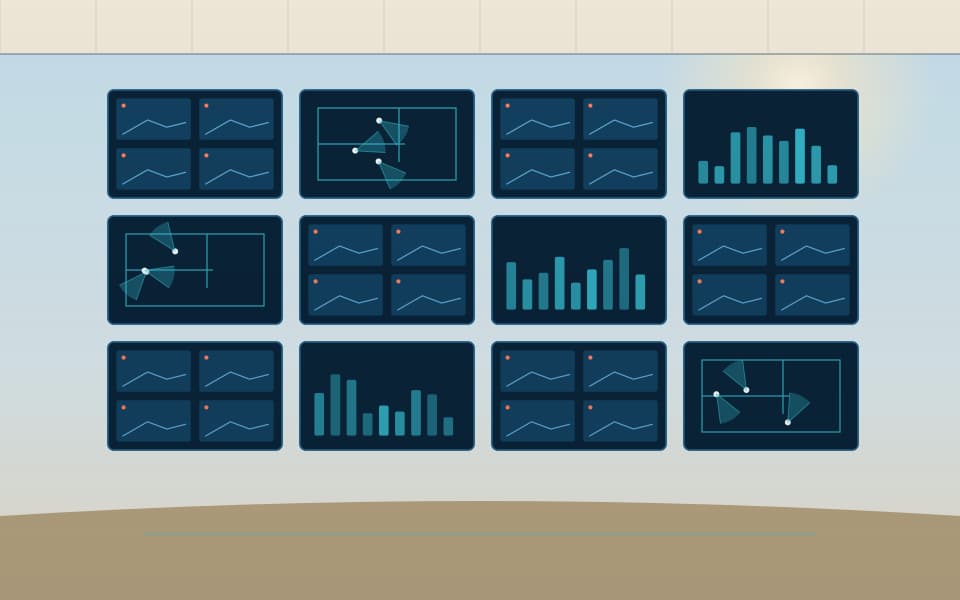
Storage is sized from measured bitrate, not datasheet figures. Bitrate depends on resolution, frame rate, codec, scene activity and night noise. A busy scene at night can double the daytime average. H.265 and smart codecs usually reduce bitrate considerably compared with H.264, but only if the VMS, client workstations and any analytics support them end to end.
Retention is a policy decision: your security policy, insurer, landlord or the authority responsible for your facility may set a minimum. We size for the stated period plus a margin, and we record what the system actually holds at handover.
Recording storage estimate
Use the average bitrate you measure on site, not the datasheet maximum. Results are decimal (1 TB = 1,000 GB), before file-system overhead.
Recorders also need write bandwidth headroom, disk redundancy (RAID 5/6 or equivalent) and a plan for disk replacement. For larger estates we consider failover recorders so a recorder fault doesn't create a gap in evidence.
Network, power and cybersecurity
An IP camera system is a network. We design it as one: dedicated VLANs or a physically separate network, managed switches with enough PoE budget per port class, and uplinks sized for the aggregate stream.
| PoE standard | Power at switch port | Power available at device | Typical load |
|---|---|---|---|
| IEEE 802.3af (Type 1) | 15.4 W | 12.95 W | Fixed indoor cameras |
| IEEE 802.3at (Type 2) | 30 W | 25.5 W | Cameras with IR or heaters |
| IEEE 802.3bt (Type 3) | 60 W | 51 W | PTZ, multi-sensor |
| IEEE 802.3bt (Type 4) | 90 W | 71.3 W | High-power PTZ with heaters/wipers |
Copper runs stay within the 100 m Ethernet channel limit. Beyond that we use fibre with media converters or remote switches, and we put long outdoor runs on fibre anyway to avoid surge paths.
Hardening is part of commissioning, not an extra: unique credentials per device, default accounts disabled, unused services closed, firmware recorded and updated through a controlled process, time synchronised across all devices so evidence timestamps agree, and remote access only through a route your IT team approves.
Specialised and high-performance video
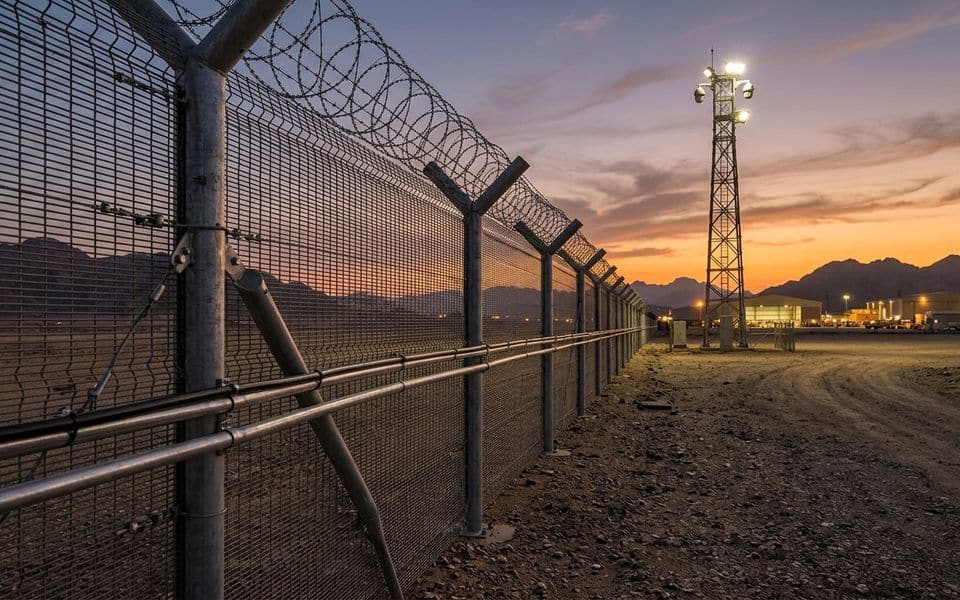
Some areas need more than standard cameras: long-range perimeter views, thermal cameras for detection in darkness or haze, explosion-protected housings for hazardous areas, ANPR at vehicle entries, and video analytics for line crossing, loitering or occupancy. These are designed as specific answers to specific risks, with their limits stated. Analytics, for example, are tuned and tested on site against real scenes before anyone relies on them.
Our part, start to finish
What we do on a CCTV project
We don't sell the equipment. We design the system, install and commission it, and keep it working.
Design & consulting
- Operational requirement per camera position
- Pixel-density and field-of-view plans on your drawings
- Storage, bandwidth and PoE calculations
- Vendor-neutral specification and BOQ
- Security assessment of existing systems
Installation
- Containment, cabling and termination (second fix)
- Camera, recorder and switch installation and programming (third fix)
- View alignment against the agreed field-of-view plan
- Cyber hardening and time synchronisation
- As-built drawings, IP schedule and handover
Maintenance
- Lens and housing cleaning, view checks
- Recording health and retention verification
- Disk, fan and power supply checks
- Firmware management
- Fault response under the contract SLA
Before you buy
Questions to settle first
These decide cost and performance more than the brand on the box. We work through them with you at survey stage.
- What must each critical camera achieve: detect, observe, recognise or identify?
- How many days of footage must you keep, and who sets that requirement?
- Who exports footage, how, and who can see live views?
- Does the system share a network with IT, or is it separate?
- Which areas need night performance, and how will they be lit?
- Who maintains it after handover, and how will faults be reported?
- Will you need analytics, and has anyone tested them on your scenes?
- Is there an existing system we must integrate with or replace in stages?
Works alongside
Related systems

Gallery
CCTV in context
Illustrations show typical arrangements, not specific projects. Select an image to enlarge it.